.jpg)
How teams can close the discovery‑delivery gap to ship real value faster with AI.


For all the talk about agile, empowered teams, and continuous discovery, most product organizations still struggle with the same fundamental issue: the features delivered rarely reflect the opportunities discovered.
Discovery happens in one set of tools, delivery in another. Insights live in Notion pages, spreadsheets, or someone’s head, while engineering work in Jira and ship features disconnected from the original customer problem.
This discovery‑to‑delivery alignment gap is the silent killer of product velocity, customer value, and organizational trust, and in an era where AI accelerates engineering output, the cost of misalignment is rising fast.
This article explores why discovery‑to‑delivery alignment breaks down, what high‑performing teams do differently, and how modern product organizations can create a seamless flow from customer insight to shipped value.
Many companies put a heavy emphasis on delivery - they focus on whether you shipped what you said you would on time and on budget - while under‑investing in discovery, forgetting to assess if you built the right stuff." Teresa Torres -Continuous Discovery Habits
Most teams don’t fail because they lack ideas. They fail because they lack alignment. Discovery produces insights, opportunities, and hypotheses - but delivery teams often receive only features, tickets, and deadlines.
The result is predictable:
Stefan Wolpers, a respected Scrum.org trainer, describes this breakdown clearly in his article The Alignment‑to‑Value Pipeline: Building Product that Matter
“Misalignment leads to backlog bloat, trust erosion, and building the wrong products.”
When discovery and delivery are disconnected, teams lose sight of why they’re building anything at all.
Misalignment isn’t just inefficient, it’s expensive, for several reasons:
Discovery to delivery alignment isn’t a “nice to have.” It’s the foundation of a healthy product organization.
Despite the clear benefits, most organizations still struggle. Here’s why:
These problems compound until teams fall into the Feature Factory trap.
“The purpose of a team is not goal attainment but goal alignment..” - Tom DeMarco, Peopleware : Productive Projects and Teams
High‑performing teams treat discovery and delivery as one continuous system, not two separate phases. They create a single flow from:
Insight > Opportunity > Solution > Delivery > Learning.
This is the essence of modern product thinking: every feature shipped must trace back to a real customer problem.
Thoughtworks, a global leader in product innovation, describes this as connecting “strategy, ideation, design and delivery” into a unified flow that gets teams “from idea to market in as little as three months”. Their philosophy is simple:
“Industry leaders focus on customer problems over product features, rapid value delivery over big bang releases, and product outcomes over project scope.” - Thoughtworks
This is discovery‑to‑delivery alignment in action.
Most alignment problems stem from language problems. Sales talks in requests. Customers talk in symptoms. PMs talk in opportunities. Engineers talk in solutions.
High‑performing teams unify this language around problems and outcomes.
This means:
This creates a chain of meaning from customer to code.
When discovery lives in one tool and delivery in another, alignment breaks. Teams need a single operational system where:
This eliminates the “lost in translation” problem that plagues most organizations.
Discovery isn’t a phase. Delivery isn’t a phase. They are parallel, continuous activities. This mindset shift is essential. Discovery informs delivery. Delivery informs discovery. The loop never stops.
Below is the modern flow used by high‑performing product teams:
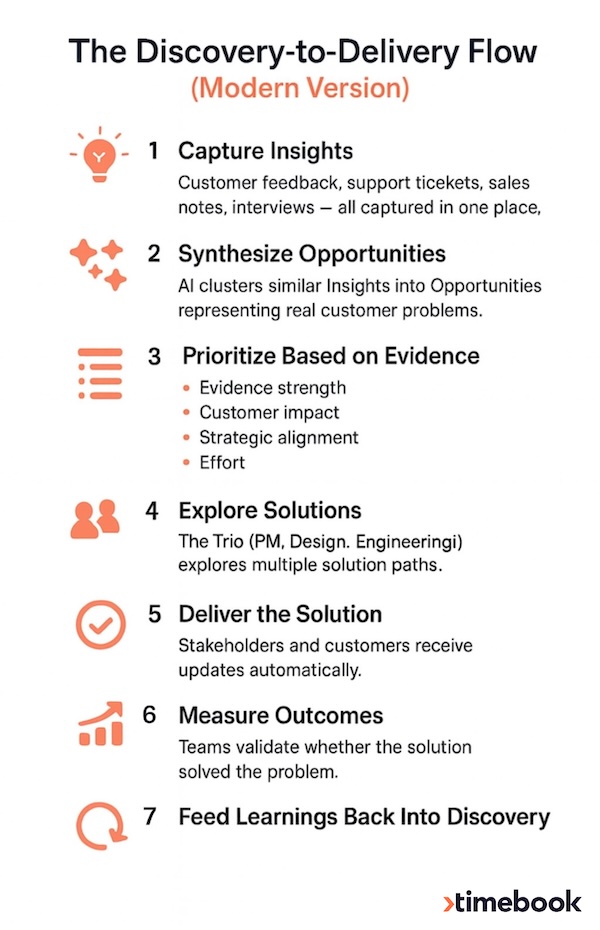
This is the continuous alignment loop that separates elite teams from everyone else.
AI is transforming product discovery, and with it, discovery to delivery alignment.
Here’s how:
This is critical because engineering velocity is increasing. As Wolpers notes:
“without alignment validated hypotheses flow into the backlog, while items deemed not valuable flow into an ‘Anti‑Product Backlog’”.
AI ensures the right work flows forward, and the wrong work doesn’t.
The Product Trio (PM, Design, Engineering) is the engine that drives discovery-to-delivery alignment. Their responsibilities are:
When the Trio works together from the start, alignment becomes natural. As Thoughtworks puts it:
“We combine evidence‑based ideation and validation with design and development expertise to help you imagine, design, build and transform products.”
The Trio is the bridge between discovery and delivery, and AI is the scaffolding that supports them.
Here’s a practical blueprint for teams who want to fix alignment:
Step 1: Centralize All Feedback: One inbox for all Insights.
Step 2: Require Problem + Desired Outcome: Every Insight must describe a problem.
Step 3: Cluster Insights Into Opportunities: Use AI to detect patterns.
Step 4: Connect Opportunities to Goals: Build an Opportunity Map.
Step 5: Explore Solutions as a Trio: Use OSTs and structured discovery.
Step 6: Sync Solutions to Delivery: Create tickets directly from Opportunities.
Step 7: Close the Loop: Stakeholders see status automatically.
Step 8: Measure Outcomes: Did the solution solve the problem?
Step 9: Feed Learnings Back Into Discovery: Continuous improvement.
Each step reinforces the next, creating a self‑sustaining alignment loop.
The future is clear:
But humans will still:
As Zaka Ullah Saif writes:
“A product manager’s greatest tool isn’t technology; it’s listening.”
AI amplifies human judgment. It doesn’t replace it.
Discovery‑to‑delivery alignment is no longer optional. It’s the foundation of modern product organizations.
Teams that master alignment:
Teams that don’t will drown in backlog bloat, misalignment, and wasted engineering cycles.
The future belongs to teams who can connect customer insight → opportunity → solution → delivery → learning in one continuous, AI‑powered loop.