Will the future of product discovery be shaped by human judgement or AI?


Product discovery has always been the beating heart of product management. For decades, product teams have relied on interviews, surveys, competitor monitoring, and manual analysis to uncover customer needs and decide what to build next. These traditional methods have shaped countless successful products, but they are notoriously slow, resource‑intensive, and prone to human bias.
In today’s environment, where markets shift overnight and customer expectations evolve faster than ever, relying solely on traditional discovery can leave teams reacting rather than leading. This is where AI enters the picture. AI‑powered product discovery workflows represent a fundamental shift in how teams gather insights, analyze data, and make decisions. They promise speed, scalability, and predictive clarity that traditional methods simply cannot match.
"Analyzing hundreds (or thousands) of customer interviews, survey responses, support tickets, and reviews is now a task that takes minutes, not months. AI models can identify recurring themes, highlight emotional language, and even flag contradictions across feedback.” David Berg - Product Discovery and AI expert
Will the future of product management be shaped by human judgment, AI or a combination of the two?
Traditional product discovery is rooted in labour-intensive, manual practices that emphasize direct human involvement. Teams conduct interviews with customers, run surveys, and analyze competitor offerings. They pore over spreadsheets, manually track market trends, and rely on intuition to interpret qualitative data.
These methods offer valuable insights, particularly in understanding customer motivations and emotions. A well‑conducted interview can reveal pain points that numbers alone might miss. A survey can highlight patterns in customer behavior. Competitor monitoring can expose gaps in the market.
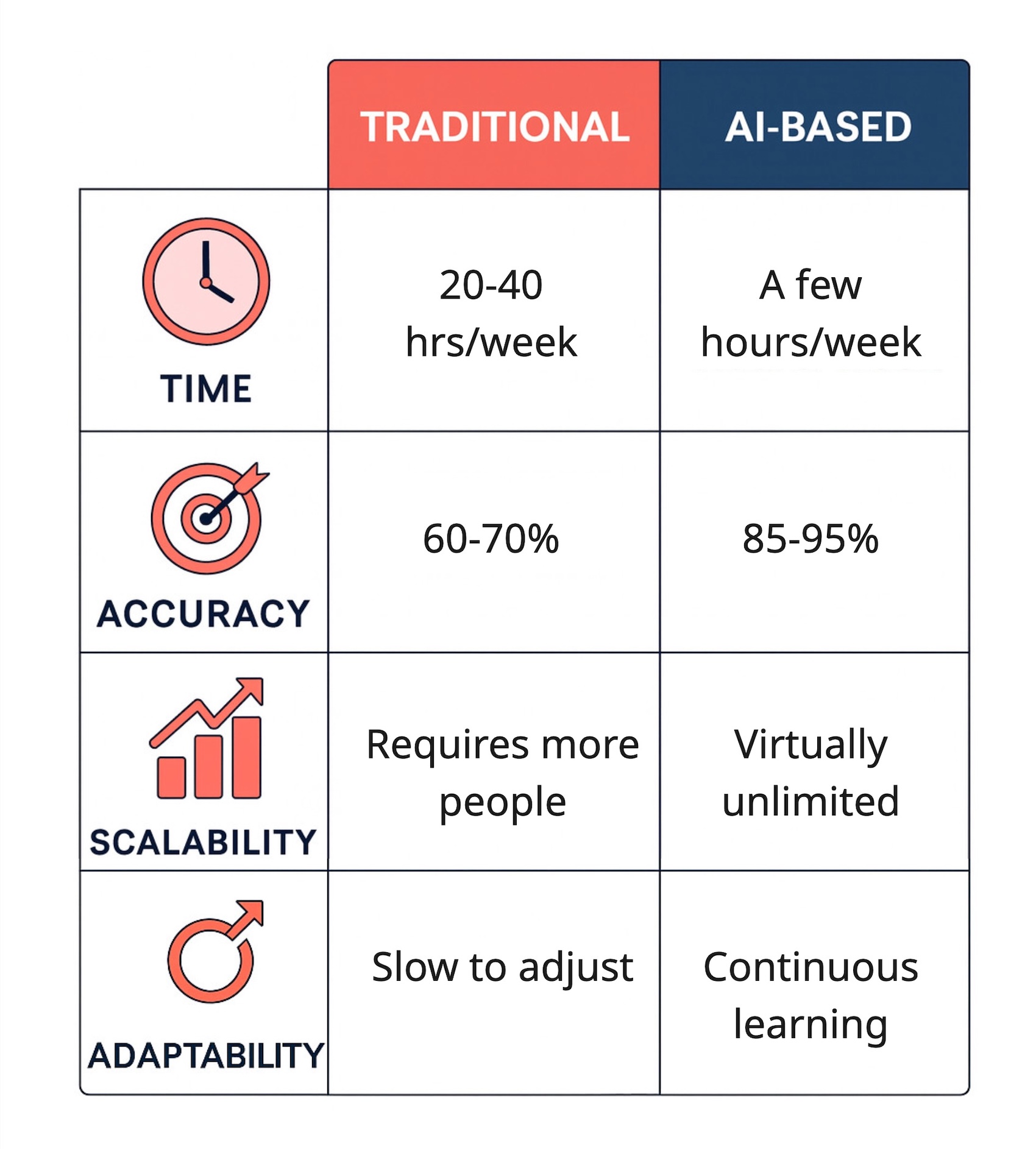
However, these methods are time‑consuming. A product manager might spend 20 to 40 hours per week gathering and interpreting data. Scaling this effort requires more people, which increases costs and complexity.
Moreover, traditional discovery is often reactive. Teams identify trends only after they have become mainstream, which means opportunities are missed, or competitors have already taken the lead.
Human bias is another challenge. Decisions can be influenced by selective listening during interviews, overemphasizing anecdotal feedback, or relying too heavily on gut instinct. While intuition has its place, it can lead to skewed priorities and missed opportunities.
In short, traditional product discovery provides depth but struggles with speed, scalability, and objectivity.
“Without a proper discovery process, teams are just running on internal opinions, stakeholder guesses, and unverified beliefs about what customers want. That’s not product management, it’s a lottery.... Ignoring these pillars means you're building on unchecked assumptions, and that's the fastest way to ship features nobody uses.” Aakash Gupta - Product Management Author and Coach
AI transforms product discovery by automating much of the data collection and analysis. Instead of manually gathering insights, algorithms continuously scan millions of signals across platforms, social media, customer feedback tools, market reports, and more. They detect subtle shifts in consumer behavior, identify emerging patterns, and forecast trends before they peak.
This automation reduces the time investment dramatically. What once required weeks of effort can now be achieved in hours. Product managers can spend less time wrangling data and more time making strategic decisions.
AI also scales effortlessly. While traditional methods require more people to handle more data, AI can process thousands of customer interactions, competitor moves, and market signals simultaneously. It learns and improves with each cycle, providing increasingly accurate insights.
Accuracy is another area where AI shines. By analyzing large datasets objectively, AI reduces the risk of human bias. Predictive analytics go a step further, forecasting trends weeks before they become mainstream. This foresight allows teams to adjust roadmaps proactively, rather than reacting to changes after the fact.
The result is a discovery process that is faster, more scalable, and more accurate than traditional methods.
“The next great product won’t be built faster, it’ll be discovered smarter.” - Sumeet Madan, Agile Coach and Trainer
The differences between traditional and AI‑powered discovery are stark. Conventional methods require significant time and labor, with accuracy hovering around 60-70%. AI‑powered workflows reduce weekly effort to just a few hours, deliver 85-95% accuracy, and scale virtually unlimited across thousands of data points.
Adaptability is another key distinction. Traditional methods are slow to adjust. If market conditions change, teams must start the discovery process all over again. AI, however, processes data in real time, learning and adapting continuously.
AI‑powered discovery offers speed, scalability, accuracy, and adaptability that traditional methods cannot match.
Despite the advantages of AI, traditional methods continue to play a crucial role. Customer interviews and qualitative research provide depth and context that algorithms cannot fully replicate. They reveal the emotions, motivations, and nuances behind customer behavior.
AI excels at identifying patterns and forecasting trends, but it cannot replace human judgment. Product managers must interpret insights, contextualize them, and make decisions that align with broader business strategies.
The future of product discovery lies in the collaboration between humans and AI. AI provides scale, speed, and predictive clarity, while human judgment ensures insights are contextualized and actionable. Together, they create a discovery process that is both rigorous and adaptive.
As markets continue to accelerate and customer expectations grow more complex, the need for AI‑powered discovery will only increase. Teams that embrace AI will not just respond to change; they will anticipate it, shaping products that meet needs before they are fully articulated.
However, the most successful teams will be those that combine AI with traditional methods. They will use AI to gather and analyze data at scale, while relying on human judgment to interpret insights and make strategic decisions.
This collaboration will create a discovery process that is faster, more scalable, and more accurate than traditional methods alone, while still providing the depth and context that only human involvement can offer.
In the end, AI is not a replacement for traditional discovery, it is an enhancement. Together, they represent the future of product management.
Artificial intelligence may be the most important technology of any lifetime, but it is most powerful when paired with human creativity and judgment.
“The best product managers use AI to inform their instincts, not replace them. They see beyond what the data confirms and imagine what it can’t yet describe... The challenge isn’t how to use AI, it’s how to remain human while doing so. Because as AI automates more of the craft, what’s left is the art: understanding emotion, designing for trust, deciding what deserves to exist.” Jeremy Daly - Seasoned Technology and Research Leader
Product discovery is evolving. Traditional methods have served teams well for decades, but they are no longer sufficient in today’s fast‑moving markets. AI‑powered workflows offer speed, scalability, accuracy, and adaptability that traditional methods cannot match.
For product teams, embracing AI is not optional, it is a strategic necessity. Those who adopt AI‑powered discovery will not just keep up with change; they will lead it, shaping products that meet customer needs before they are even fully articulated.
The future of product discovery lies in the collaboration between human judgment and AI. Together, they will create a process that is rigorous, adaptive, and future‑proof.